Sunday, April 15, 2012

keep safe these things.

This thought comes from a rather short passage in my more recent reading of the Book of Mormon.

In the first chapter of Mosiah, King Benjamin is teaching his sons the language and prophecies of their ancestors and stressing how important it is for them to remember (I love the theme of remembering that is so prevalent in the Book of Mormon). He has his son, Mosiah, come to him and tells him he will be the future king. He then gives him charge over the records (plates of brass) that contain their scriptures.

He also gives him charge over the sword of Laban as well as the Liahona.

I'd like to extrapolate some symbolism here. I feel like these three things are symbolic of what is important for us to remember and keep close to us in our lives.

Firstly the plates. For obvious reasons, the scriptures are integral to our salvation. For many it's how we received a witness that Christ is our savior, or how we get answers to our prayers. As well I'd like to add our own personal records. Journals and study journals. There we write down our own testimonies and scraps of revelation. It shows God that we value the answers He's given us, and that we want His help. It can also serve as a later guide to our family or friends. You never know who will benefit from an answer you got years ago. Including yourself.

Secondly the sword of Laban. To me it is symbolic of being obedient and understanding that the Lord has a greater plan; one that we might not initially understand. If we're obedient to the things He asks of us, we can be happy and be closer to the Spirit.

Third, the Liahona, or compass. This ties into obedience . . . as well as sensitivity and faith and diligence. If we are looking for the subtle directions of the Lord, being sensitive to the whisperings of the Spirit and then acting on them, we can see more clearly, even during our trials. Faith to act and move forward, as well as the needed directions.

So that's it. Keep safe these things and we can have the increased guidance of God.


Monday, April 2, 2012

faith. hope. charity.


This morning I read in the book of Enos (Book of Mormon) and remembered a comment that a friend made in Sunday school a few weeks back.

Enos has always been a favorite of mine, but my friend provided a different way of looking into Enos' conversion to Christ.

Enos' father was a prophet and so Enos was exposed to the teachings of Christ. However, it wasn't until later in his life that he got his own testimony of Christ. I enjoy this because it shows that he received a foundation from his father, who gave him all the necessary information to have his own testimony and then it was up to him to decide if it mattered to him. I feel like my experience was similar in that regard.

Anyway. In 1 Corinthians chapter 13, Paul says "And now abideth faith, hope, charity, these three; but the greatest of these is charity" (v13 KJV). Moroni in the Book of Mormon (Moroni 7) expands on this saying that we must first have faith, then hope and then charity. My friend pointed out why it is in this order, as illustrated by the story of Enos:

Faith
Enos goes and prays in the woods to have his sins forgiven (about 500 years before Christ). After praying all night he receives a witness from God that he is forgiven and God says he is blessed for having believed in Christ, whom he has never before seen. First came faith; a belief that he could be forgiven and would be forgiven.

Hope
Enos' faith becomes unshakable and he feels an overwhelming hope. He knows that God has forgiven him and he now has a hope in Christ. He can overcome everything because of Christ's future Atonement.

Charity
Where do Enos' thoughts turn to once he has exercised faith and received hope? First his brothers and people and then to his enemies. He wants everyone else to have the same hope and happiness that he is experiencing. He feels charity towards his fellow men and even his enemies. He prays fervently for their welfare and then receives the promise that at a later date his enemies would have access to the scriptures and a chance to believe in Christ.

First we must have faith that Christ is our Savior, then we can have the hope of returning to live with God and then we can love our brothers and sisters and help them find the same joy we have.

Sunday, March 18, 2012

God is a scientist.

"There is no difference between true religion and true science."

This was shared in institute last week. Unfortunately I cannot recall who it was attributed to.

This is so much my feeling and belief for years.

My biology professor freshman year started off the semester by explaining to us what he felt a proper mentality towards science was. He drew a line on the board and wrote "God" on one end and "science" on the other. He then said that anyone who believed in only one end of this spectrum was nuts (extremists at either end). We should believe in both, that God created the universe and that he uses the laws and principles that govern it.

Without delving deeper than is necessary, I believe that God is a scientist and that any discrepancies between religion and science are our own fault. Eventually we'll have a clear understanding of how science and it's laws are exploited by God.

Interesting fact: in the Bahá'i Faith  they believe that true science and true religion can never be in conflict. The principle states that truth is one, and therefore true science and true religion must be in harmony, rejecting the view that science and religions are in conflict. Neat-o.

You might also find some of these things that Einstein said interesting:

- I want to know how God created this world. I am not interested in this or that phenomenon, in the spectrum of this or that element. I want to know His thoughts; the rest are details.

- Science without religion is lame. Religion without science is blind.

- My religion consists of a humble admiration of the illimitable superior spirit who reveals himself in the slight details we are able to perceive with our frail and feeble minds.

And finally, something from the Book of Mormon. "Thou hast had signs enough . . . and all things denote there is a God; yea, even the earth, and all things that are upon the face of it, yea, and its motion, yea, and also all the planets which move in their regular form do witness that there is a Supreme Creator" (Alma 30:44).


Sunday, March 4, 2012

promises.

Before I start, I want to say this: God always fulfills his promises.

While reading in the Book of Mormon this week in 2nd Nephi, I was impressed by something in the 10th chapter.

Jacob, Nephi's brother, is talking to his people (circa 559 BC) about Christ's future coming among the Jews. He mentions that they (Nephi's people) have received a promise, and despite prophecy of the consequences of future disobedience, that God will be merciful and that their descendants (in his own time) will eventually be restored and know their Redeemer.

The promise? That God will give future generations a fullness of knowledge of Christ. The time table? More than a thousand years . . . But the promise was fulfilled, and the descendants of the Book of Mormon, wherever they are, have access to the complete and full knowledge of Christ's sacrifice.

But what most intrigued me most was this:

Jacob talks about the Lord leading groups of people to different areas at different times, he even emphasizes "isles of the sea," saying, "the Lord God has led away from time to time from the house of Israel, according to his will and pleasure. And now . . . the Lord remembereth all them . . . wherefore he remembereth us also" (10:22).

I feel like, at least in my own life, God has had a very direct hand in leading me sometimes. I feel very good about a direction and path I'm taking, or a destination that I have "arrived" at. Then it feels like I'm on my own for a little while. God expects me to act and use what he's given me; to exercise my own free will.

In these times, and in times of challenges we wonder, when is this going to be like He promised me? Often times, we get clear promises from God, or the council that everything will be alright. We wonder, "well right now would be a good time for that to be true. God promised me. I'm ready for it to be better already."

As Jacob points out, those promises always come, "for [God] hath spoken it, and who can dispute?" (10:9)

I definitely don't know God's timetable for fulfillment of promises he's made with me. But I know that if I am righteous and strive to use my agency wisely . . . the promise will be fulfilled. Tomorrow. Or in 5 years. The Old and New Testaments, and the Book of Mormon are clear evidences that God remembers and keeps his promises.


Sunday, February 12, 2012

sensitivity.

The Spanish word for sensitive is "sensible." Looks a lot like our English word sensible.

Interesting . . .

Sensible for us means something clear or wise. Practical. Functional. Beneficial. The archaic meaning is "able to notice or appreciate." I especially like this last definition.


Able to notice or appreciate.

I think we all would like to have this ability. To be sensible to the needs of people around us, or to the impressions of the Spirit.

In my calling I've recently had the opportunity to teach the various teachers about loving those they teach. What I got of it was having the sensitivity or sensibility to know what people need, who they are, what they've been through and how God sees them. Christ was the best example of this ability. He was in constant communion with the Holy Spirit. He always knew what people were feeling and needed. He was even able to perceive their thoughts.

Sensitivity to the Spirit has been one of my greatest desires over the last few years. Unfortunately, it's something that I sometimes lose sight of. However, I do feel that it is something that is attainable or at least possible for the majority of the time.

Praying for it. Living my life so that I won't be too distracted when the feelings come. I think that is the most difficult part. There is so much, especially in today's world, to distract us from the quiet whispers and feelings of the Spirit.

Anyways . . . I hope to be able to grow in my sensibility to the Spirit.

Monday, February 6, 2012

for your good.

Bad things happen. Inconvenient things happen. Even when we're trying to do what's right and live a balanced life. Our plans get messed up and we wonder sometimes if anything more could possibly go wrong. I've realized recently though, despite the consequences of our agency or of things outside our power, there is always something positive that can come from these situations.

This past Friday, through no real fault of my own, I was left behind. My entire class went on a field trip. Without me.


My professor had been adamant that we were leaving at 9:00 am sharp. I got out of my German class at 8:50. I was doing fine on time and as I biked past our meeting spot, there were only a handful of students. I parked my bike and decided the forty minute drive to Salt Lake would feel much much longer if I did not make a visit to the bathroom.

As I came out of my building around 9:01 I realized that the vans were gone. My initial response, “Are you kidding me?” So I called the vans. One was full. The other was being driven by my professor. He didn't want to turn around and pick me up. I guess my learning experience wasn't worth five extra minutes driving.

I was annoyed, but decided to use the next three hours to work on my prototype for another class in the shop. I ended up running into one of my professors I don't have a class with this semester. He's a professor whose design opinions and philosophies I respect highly. We got talking about internships and he told me I should apply to this summer's program in a far away land. I was doubtful of my ability to get it while other, more experienced students would by vying for the same position. He gave me a huge confidence booster, telling me that I could compete. So now I'm planning on doing the design test and applying for the program.

Though I missed an opportunity to see how plastics are blow-molded, which of course God didn't wish upon me, I was able to have a productive work session and get some direction from a professor I was in need of. Like God counseled Joseph Smith, if the very jaws of hell should gape open wide after you, know it is for your good. We don't always know why things happen to us, and most of the time, they just do, but God has a great way of giving us something else worth having.

Frustration happens. Bad things happen. There is always something good to be learned or gained.

Sunday, January 29, 2012

the correct tool.

Recently, I put a new bike seat on my bike and oiled the chain so that it wouldn't squeak anymore. I was reminded of a metaphor I learned on my mission a few times and of what it means to me.

Here are a few short stories to illustrate my point:

The Accident (on my mission in California) - Elder Olofson and I had been together for a few months and we were starting to get along really well. We were on our way to visit Judith to talk to her about getting baptized. Josh Groban may have been distracting us, but as we came over a small hill we saw a green light, but the truck in front of us was completely stopped. 

Olofson slammed on the brakes and we avoided the truck, swerving to the right. We looked at each other and exhaled. Then the car behind us slammed into our rear. The guy's car was totalled, but we were fine. After everything got sorted out we realized that there was a piece of shrapnel stuck in our muffler:


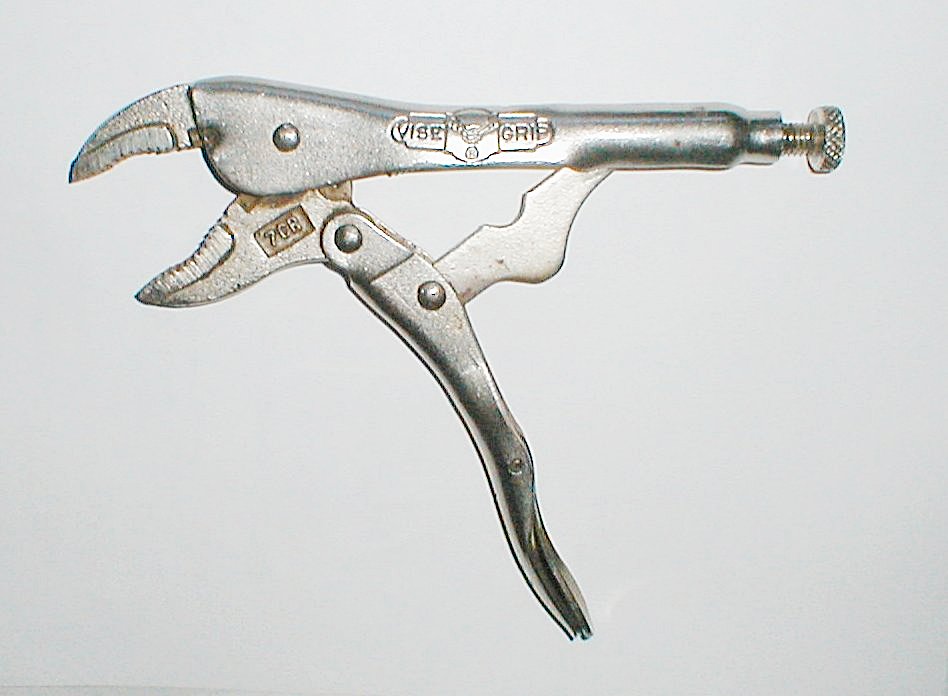
This little guy proved impossible to remove; until the Zone Leaders showed up with this tool:


Locking pliers. With some effort we got it dislodged. It took the proper tool to fix our problem.


The Toilet (on my mission in California) - Clogged toilets are the worst thing ever. We were living with members and tried every single thing imaginable to try and get the toilet unclogged. Finally, we asked the family if they had a plunger. Took about 5 seconds to get the toilet clear. Again. A problem that could only be fixed with the correct tool.


The bike saddle - I hated the bike saddle on my bike. It was uncomfortable and made me slide forward. So I took a bike saddle my brother had lying around to replace it. I needed a Hex key to change the saddle. There were none to be found in the house. I tried some other stuff and ended up buying a Hex key at the bookstore. It took the aid of a hammer to get the nut loosened, but it worked.


The metaphor I see in all of this is repentance and the Atonement. We've all made mistakes and done things that we regret. Sometimes it just takes saying we're sorry, or never doing it again. Sometimes it takes a whole lot more than that.

 Sometimes the Atonement takes the form of a hammer. Sometimes it takes the form of a bulldozer. The point is, there are problems that we cannot fix ourselves. Only by going through the proper steps of repentance and applying the Atonement in our lives can we be made right again.

The Atonement of Jesus Christ is accessible to all of us at no cost. It is the only correct tool to receive forgiveness and confidence in God's presence. 


Sunday, January 22, 2012

deliverance.

A few days ago as I was reading in Ether (Book of Mormon) I was struck by an impression.

The people of Jared had a hard time with staying righteous and were greatly influenced by the kings who ruled over them. When there was a king who followed God, the people usually followed suite. When the king would rather kill his dad for the throne than wait around and maybe inherit it, their society tended to decay.

One king, Shule, made sure that the prophets could come in and call his people to repentance. The people fixed their lives and were blessed for it. What was the reason that Shule, unlike a few kings before him was concerned with what God wanted?

"And there were no more wars in the days of Shule; and he remembered the great things that the Lord had done for his fathers in bringing them across the great deep into the promised land; wherefore he did execute judgment in righteousness all his days." (emphasis added, Ether 7:27)

So. Shule remembered how God had spared his ancestors from the Tower of Babel and brought them to the Americas.

Sound a little familiar?

In the Old Testament there are countless times where the children of Israel remember how their ancestors were delivered from Egyptian captivity (or didn't and roamed around in the wilderness, or were conquered and put into captivity again) and this led them to live the commandments of God. Nephi and his righteous descendants always looked back on their "Exodus," from Israel to the American continent.

So what is my point? Every group of righteous people had something in common. They remembered how God had delivered them. When he had taken them in His mercy and put them in a much better situation where they could be blessed if they would stay faithful to him.

It led me to ask myself, what event in my life has been the foundation of my belief and testimony? What can I always look back on to renew my desire to live correctly? I have a certain night in mind where God answered one of my prayers. So I suppose you can call it my "Exodus," my figurative deliverance from captivity.

Which deliverance do we remember to keep us strong?

in every thought.

so i recently had the idea of sharing some of the insights and things i learn in my studies and life. this blog is an attempt to share things that i find interesting, or help me to live the life God would want me to. i hope it will help me to develop some of my impressions into full thoughts.

the name "in every thought," comes from a scripture i've been being led to semi-frequently in Doctrine and Covenants (6:36), "Look unto me in every thought; doubt not, fear not."

the scriptures have been a very treasured thing to me over these past four years. i've found a lot of answers and guidance in them. which makes sense. they are answers and guidance to God's children, so i should be able to relate my own life to theirs. maybe you're even looking for the same answers that i am.

D&C 42:62 "If thou shalt ask, thou shalt receive revelation upon revelation, knowledge upon knowledge, that thou mayest know the mysteries and peaceable things––that which bringeth joy, that which bringeth life eternal."